Book in the spotlight: The Erl-King by Michel Tournier
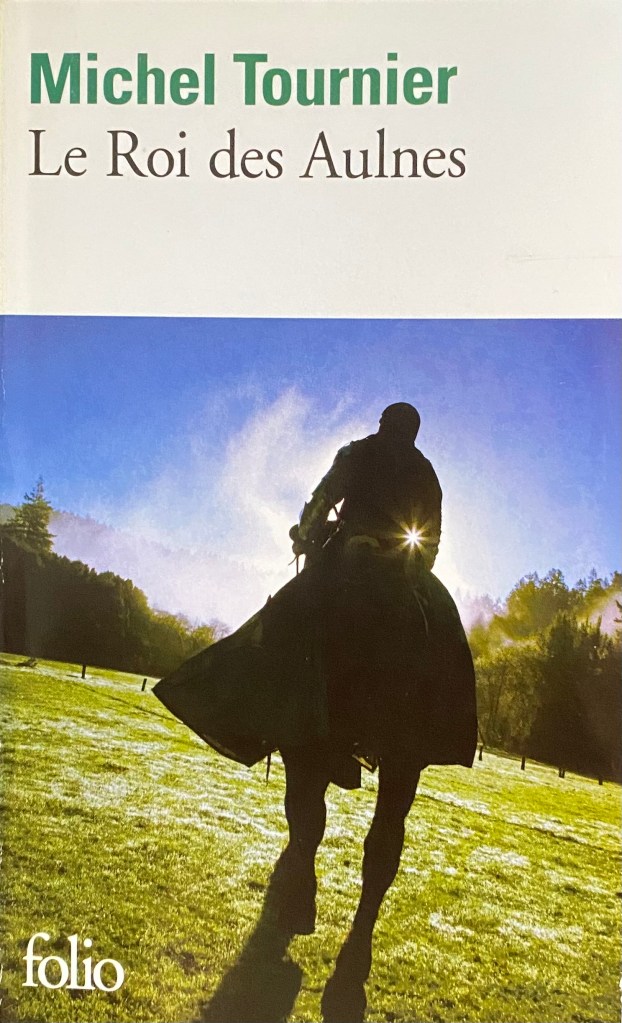
In Goethe’s poem “The Erl-King,” a father and his son are traveling through a forest on horseback. The little boy takes fright, and when the father asks him what’s wrong, the boy says the Erl-King, a malevolent elf who preys on children in the woods, is there to snatch him. Initially the father dismisses the Erl-King as the work of a child’s imagination inflamed by the sylvan surroundings. But the Erl-King does not leave the boy alone. First tempting him with rewards, the Erl-King grows more belligerent and threatens to seize the terrified child by force. Increasingly anxious, the father urges the horse to gallop ahead, but it is too late. The Erl-King has got his catch and, by the time the father finally reaches home, the boy is dead.
This eerie poem underwrites both the title and the plot of The Erl-King, a novel by the French writer Michel Tournier. Mostly unknown to English-speaking readers, this remarkable, strange work tells the story of a very tall and very myopic weirdo by the name of Abel Tiffauges. The novel is broken into two periods. The first is centered on the France of the late 1930s, with frequent mnemonic voyages to Tiffauges’s childhood. This part is told by Tiffauges himself. Using journal entries that he calls “sinister writings” (a play on words – Tiffauges has injured his right hand and is forced to write with his left), Tiffauges recounts his evolution from a sensitive misfit at an all-boys religious school to the creepy owner of a Parisian garage who spends his free time haunting school playgrounds to photograph children and record their voices. This goes on until a girl accuses him of molestation. Tiffauges is arrested but, fortunately for him, this coincides with the outbreak of the Second World War. The case is dropped, and Tiffauges is drafted into the army. With that, the first part ends, and the story shifts to a third-person narrative. We are now strictly in the realm of the present and, presumably, of the objective.
Following a picaresque series of adventures on the front, Tiffauges is taken as a POW and dispatched to a Prussian labor camp. Catching the eye of Goering’s forester, he eventually finds an unlikely home at the Kaltenborn fortress, a Napola institution for boys selected to become the elites of the future Lebensraum. At that quintessentially Nazi place, Tiffauges makes himself useful by scouting the region on horseback in search of new Aryan-looking recruits. Far from realizing he is collaborating with a diabolical system, Tiffauges believes he is living in a hyperborean land of magic. His enchantment lasts until the tide turns against the Germans, and the world that Tiffauges mistook for a fairy tale turns out to be hell. As the Germans retreat, the horrors of the Nazi system are laid bare, and an encounter with a young boy who has survived Auschwitz causes the scales to fall from Tiffauges’s eyes. His improbable journey ends in an appropriately apocalyptic, Götterdämmerung way.
The apparent superficiality of the plot belies the novel’s thematic depths. Tournier draws on mythology and Christian doctrine to weave different ideas throughout the text, layering it with metaphors, symbols, and any number of possible interpretations. Nothing is random here; everything has a meaning. This includes the main protagonist’s name. Standing in France, the Tiffauges Castle was once inhabited by Gilles de Rais, a notorious 15th-century serial killer of children. The nobleman’s grisly crimes earned him the sobriquet “Bluebeard”; incidentally (or not – remember, nothing is incidental in this book), Tiffauges calls the horse he rides while looking for young children Bluebeard, though the narrator claims the name is on the account of its hair bristles. You’d think the meaning behind “Abel” is pretty obvious, but things are not so simple. In one of his philosophical musings, Tiffauges writes that Cain was a laborer and Abel a herdsman. This means that Cain represented a sedentary lifestyle, while Abel was a nomad. The conflict between the settled and the nomad – the persecution by the former of the latter – has never ceased, and so Abel is Abel not because he is good, but because he is rootless. This is one of the major themes of this book, even if Tournier, in his somewhat chaotic way, never quite develops it. At one point, Tiffauges witnesses an examination of a well-preserved 1st-century body pulled from a Prussian bog. The Nazi professor of archeology presiding over the examination of the body names the distant German progenitor the “Erl-King” – the discovery makes the professor, the good Nazi that he is, think of Goethe’s ballad, that “quintessence of the German soul.” The recovered body is thus a symbol of Cain, the sedentary man. This is what Abel – Tiffauges, not the biblical Abel – wants to be and, depending on one’s interpretation, succeeds in becoming in the end. The wintry austerity of Prussia’s landscapes that Tiffauges finds so spellbinding offers him the possibility of shedding his own rootlessness, and therein lies the appeal of the Nazi world.
Tiffauges would find this interpretation reductive. In his own telling, Tiffauges predates the Bible. He starts his “sinister writings” by claiming to have been around more or less forever; he was already in existence when the “earth was only a ball of fire spinning in a sky of helium.” A kind of supernatural being, then. I am not sure I am prepared to take him at his word; the idea of a man who has devised “caca-shampooing,” a morning ritual that involves placing one’s head in the toilet bowl and then flushing it, as a supernatural being is a bit of a stretch. But not for Tiffauges. Or Tournier. The Erl-King is the only novel that I can think of that easily juggles both scatology and eschatology. In Tiffauges’s world, feces take on a metaphysical dimension, acquiring sacerdotal veneration. There are lengthy, fairly graphic descriptions of people and animals having bowel movements, and I would hardly be taking things out of context by using the following as a summary of Tiffauges’s worldview: “Constipation is a major source of moroseness. How I understand the Great Century with its mania for enemas and purges! What man is most unable to come to terms with is being a two-legged sac of excrement.” That’s one way of looking at it. In the preceding paragraph, Tiffauges describes being moved by the shape of his turd, “this beautiful baby . . . I’ve just given birth to, and I regain my taste for life.” Feces are “Omega”; defined as “the ending,” that which is “the last,” in the Book of Revelation, the finality of Omega here seems to be a symbol of man’s communion with the soil and, therefore, Cain and the settled life.
In his diary, Tiffauges offers what he calls a “sinister constitution.” Tiffauges’s political desiderata, the “constitution” comes down to doing away with those in government. Tiffauges loathes authority, and his anarchist streak goes back to his days at Saint Christopher College, an all-boys religious school that excelled in turning students into moral cripples. Tiffauges was relentlessly abused by students and teachers alike; in one incident that traumatized Tiffauges for the rest of his life, a bully forced him to lick his wound. His torment lasted until the precocious Nestor (possibly named after Nestor, king of Pylos), the untouchable son of the school’s concierge and another weird character of supposedly supernatural origin, took him under his wing. Years later, Tiffauges is dragged to witness the macabre public execution of the serial killer Eugène Weidmann. He identifies with Weidmann, if not with his crimes – both were born in 1908, both were only children, and both are very tall, so much so that their physical resemblance is noted during the execution. Tiffauges views the execution as an act of legal murder sanctioned by the authorities, and the refusal of President Lebrun to show clemency by staying the death sentence serves for him as further confirmation that the greatest criminals are those in power. Wrongly accused of having molested a child not long after the execution, Tiffauges finds himself, yet again, at the mercy of the authorities. Everything that happens to Tiffauges in the wake of the Second World War is therefore viewed as a kind of emancipation, even though, as a POW, Tiffauges can hardly be said to be free. But any escape from the old order is liberty: “And the sky has responded. The society that had made Tiffauges suffer was swept away, along with its magistrates, its generals, and its prelates, its codes, its laws, and its decrees.”
But what is the new order that Tiffauges embraces with his childish naivety, the same gullibility that makes him yearn during a visit to a government office for a “good tyrant who will, with the stroke of a pen, suppress” all the paper appendages of bureaucracy? At the Prussian Napola, he drifts close to Professor Otto Blättchen, an Ahnenerbe type possibly inspired by the real-life figure of Wolfram Sievers, a onetime bookseller who became colonel of the SS and was eventually tried at Nuremberg. Blättchen examines each new arrival assiduously, taking measurements for the benefit of his racialist pseudoscience. Like everything else at Kaltenborn, the work fascinates Tiffauges. Wilful blindness or sancta simplicitas? This is a complex question. Tiffauges is creepy, but is he a monster? For all his unhealthy fascination with children, he is not a pedophile, and the girl who accuses him of molestation does so because he is the first person to arrive when she is assaulted and screams for help. At Weidmann’s execution, surrounded by a mob hankering for blood, he seems to be the only vestige of humanity, and he vomits when Weidmann is done away with. Carting children off to the Kaltenborn fortress, where they will perish while resisting the Red Army, he embodies less the Erl-King of Goethe’s poem than its father, heedless of the Erl-King threatening the children until it is too late. In the end, he redeems himself in a way by saving a Jewish boy from death, though how he is judged in the great beyond prefigured by the Book-of-Revelation scenes in the last pages, we do not know. Evil and good are inverted, rendering definitive moral judgments difficult.
Along with inversion (the word is repeated throughout the text with a clamorous insistence), one of the major themes in The Erl-King is that of phoria. Actually, it is the main one. Phoria is a biblical concept that takes on religious and mystical connotations in the novel. Anyone who has read the Book of Genesis attentively knows that the story of the creation of man is told twice. In the first account, man and woman are created at the same time. In the second one, God first creates the man and then the woman. Tiffauges provides his own interpretation to settle the divergence. God first created a hermaphrodite; when the creation was found wanting, the hermaphrodite was split into two distinct genders. The Fall of Man was not the loss of innocence caused by tasting the forbidden fruit, but the loss of man’s original hermaphroditism. As a hermaphrodite, man bore within him a woman; more importantly, he also bore within him a child. This act of bearing is phoria, and it is central to the novel. Christ, of course, bore his cross (and the cross then became the symbol of Christ, representing an instance of inversion). But the real exemplar of phoria in Tournier’s novel is not Christ but Saint Christopher. Drawing on Jacobus de Voragine’s medieval The Golden Legend, Tiffauges relates how the saint, after endless peregrinations in search of Jesus, followed the advice of a hermit to settle down next to a river to carry people across the water. One day, a boy appeared and asked to be shuttled over to the other shore. The boy proved too heavy to carry, and Saint Christopher nearly drowned during the riverine crossing. Once he made it to the other shore, he found out that the boy he had carried on his shoulders was Christ Himself.
Tiffauges fancies himself as a latter-day Saint Christopher. His mission is to regain his prelapsarian state by becoming a child-bearer (porte-enfant). This is Tiffauges’s great destiny and one that, by his own lights, he manages to fulfil. But if man is an agent of phoria, where does that leave women? In Tiffauges’s world, more or less nowhere. His interpretation of the Bible makes women superfluous, and there are precious few of them in The Erl-King. The school Tiffauges attended (named after the child-bearing saint) is, as has been mentioned, an all-boys school, and the only female at the Kaltenborn fortress is Frau Emilie Netta, the citadel’s Heimmutter. Even the children Tiffauges bears as porte-enfant are boys. But if women don’t enter the equation, horses do. The horse, an animal that enjoys a special significance in the novel, is a natural symbol of phoria. What’s more, by dint of its anatomy it is a symbol of Omega – observing the bowel movements of his own Bluebeard, Tiffauges concludes that the horse is the “Genius of Defecation” and the “Anal Angel,” whatever that means. Tiffauges’s ultimate redemption as an agent of phoria is also equine in nature, and the Jewish boy he rescues calls Tiffauges the “Horse of Israel” (Cheval d’Israël). The father from Goethe’s poem has been transformed into the poem’s horse.
One other theme, buried so deep in the text it seems to have been overlooked by most readers, is that of the father figure. Saint Christopher initially set out looking for the most powerful prince in the world he could serve. He found a powerful king, but when the king made the sign of the cross to ward off the devil, Saint Christopher abandoned him to search for the devil. He entered the service of a fierce warrior who claimed to be one, but the warrior’s dread of the Christian cross also exposed him as a fraud. The search for the world’s most powerful prince ended only when the saint finally transported Christ across the river. As one revelatory scene suggests, Tiffauges is also looking, subconsciously perhaps, for the world’s most powerful prince. Entering the municipal buildings in a German town while still in the employ of Goering’s forester, he is shocked to find himself in a room full of naked teenage girls. A similar scene is unfolding at the municipal theater, only there it is all boys. The teenagers are undergoing a medical examination before being admitted into the Hitler Youth. Tiffauges is told that this is an annual tradition held on April 19th, the day before the Führer’s birthday. Upon hearing this, Goering’s stock immediately tumbles in Tiffauges’s eyes; his master is eclipsed by the Führer, a man so powerful he is given an annual tribute of hundreds of thousands of German youths.
Nothing is said about Saint Christopher’s family, of course, but we do know from Tiffauges that he had an aloof, taciturn father who showed him nothing but indifference. There is an unforgettable scene in which Tiffauges flees his school in anguish, but when his father retrieves him at the train station, he coldly says he’d send him back immediately if only the train schedule let him. Relations between father and son were so strained Tiffauges went to work for a competitor after a brief stint as an apprentice at his father’s garage. Of his mother, however, Tiffauges says nothing – or else my memory fails me. It’s as though he’d never sprung from a woman’s womb. And the children his own phoria is concerned with are boys. One wonders if Tiffauges’s fascination with the world’s most powerful prince is not an expression of his need for a father figure to take the place of a father that he never had, and whether his phoria does not correspond to a desire to satisfy intense paternal feelings that were never spent on him. Seen that way, his role as the father from Goethe’s poem acquires its own symbolics.
From a purely literary standpoint, parts of the novel are magnificently written. This has not saved the book from isolated charges of controversy. While you can find controversy anywhere if you look hard enough, there is without question a rawness to the text that makes for uncomfortable reading. Tournier lures the reader into some inhospitable labyrinths that threaten the unprepared with asphyxiation. It is noteworthy that the novel is dedicated to the “defamed memory” of Rasputin – noteworthy because one of the entries of Tiffauges’s “sinister writings” exalts Rasputin as a pacifist, saintly figure whose healing powers saved the tsarevich’s life and made Rasputin a “grand phoric hero of our time.” The positions of the author and his “ogre” thus overlap. To be sure, this is hardly tantamount to exclaiming, “Abel Tiffauges, c’est moi!” Nor am I convinced that this novel glorifies violence, much less that it is an apologia for fascism. If The Erl-King is controversial, it is more on account of its intellectual promiscuity – a literary work that lends itself to manifold interpretations is bound to leave the door open to various accusations. Ultimately, though, the reader’s judgment of The Erl-King will depend on whether the reader believes a novel that places Christ right next to horse turds is an acknowledgment of life’s all-encompassing vitality, or whether it is merely a sign of bad taste. The one thing that can’t be taken away from this book is its relevance. At a time when, politically speaking, the f-word is once again in vogue, this 1970 Prix Goncourt winner still has a compelling story to tell for those with the stomach to hear it.
 The Writings of Scriptor Adorans