Book in the spotlight: The Gnostic Gospels by Elaine Pagels
In late 1945, a peasant getting ready for an honor killing unearthed a one-meter-long red earthenware jar near the Egyptian town of Nag Hammadi. Tempted by the thought that the jar might contain gold but also concerned that a jinn (a spirit) might be lurking inside, the man hesitated at first. When human greed carried the day and the jar was finally smashed, the peasant was in for a surprise – instead of gold or a spirit, he found thirteen leather-bound papyrus books. Probably underwhelmed by the discovery, and certainly unaware of its significance, the man took the codicils home, and his mother used the loose papyrus leaves to kindle the fire in the oven. The books – fifty-two Coptic texts attributed to gnostic authors – were preserved all the same and, following a colorful story worthy of a Dan Brown crowd-pleaser, eventually made available for study under the name of the Nag Hammadi Library. Billed as a seismic shift in the field of early Christianity, the texts caused a sensation, spawning a cottage industry for religious scholars.
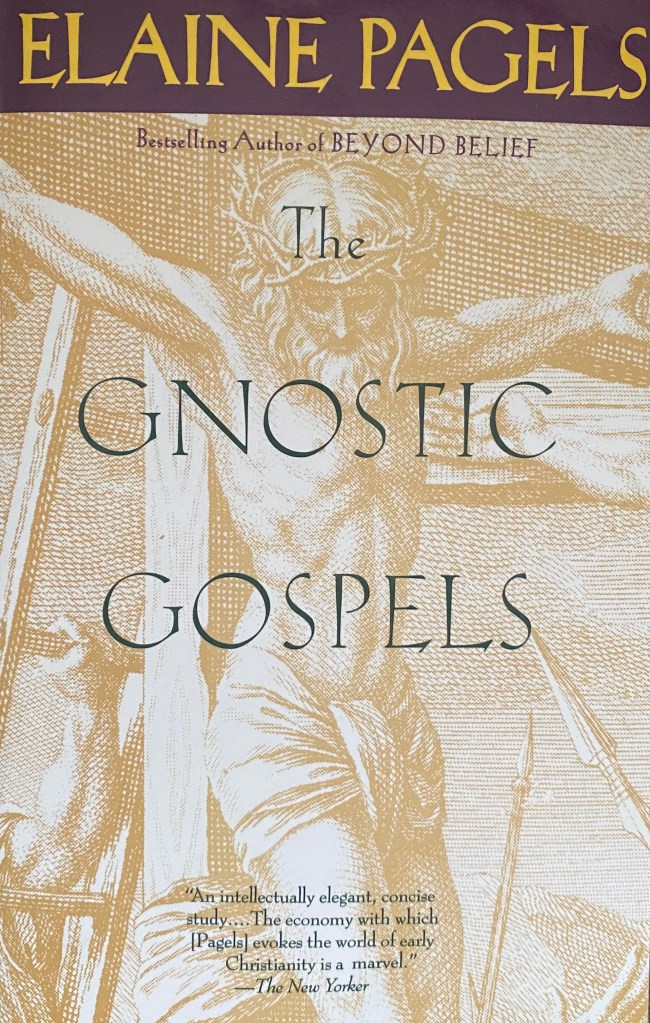
The Gnostic Gospels by Elaine Pagels was a major beneficiary of the discovery. The book reached the bestsellers list, snagged several prestigious awards, and launched a stellar career for Pagels, presently professor of religion at Princeton University. More than forty years after its publication, there is no sign that its reputation has diminished. The Gnostic Gospels continues to be the reference book on the gnostics, floating to the top of any search results for relevant literature; Google’s AI makes it its top recommendation; and a prominent scholar has written that he routinely assigns the work to his undergrads. This is clearly not a book in need of being rescued from oblivion, and if I am choosing to write about it, it is precisely because its acclaim is out of all proportion to its merits, and bright warning lights are required for new readers on approach.
The thesis – and Pagels packs a big one into less than 150 pages – is laid out in the introduction. Acknowledging the lack of consensus on the gnostics’ origins among scholars, Pagels states that the question is of only secondary importance to her. She is more interested in “how gnostic forms of Christianity interact with orthodoxy – and what this tells us about the origins of Christianity itself.” What this means is that Pagels emphasizes the sociopolitical dimension of these interactions and discounts the theological one. The story as told by Pagels goes something like this. The dawn of Christianity was marked by the proliferation of different Christian groups and sects, with hundreds of religious teachers vying to represent the authentic teachings of Jesus. The gnostics were one of the sects trying to win the battle for Christian hearts and minds. But it was not to be. As the Christian world consolidated, it became dominated by orthodox (literally, “of the right opinion”) Christians, who elbowed out their opponents and seized control of the narrative, along with the power to adjudicate on matters of religious purity. The gnostics went down in history as heretics only because history is written by the winners and the gnostics were not among those who had won. Conceding that some of the beliefs held by the gnostics might seem outlandish to orthodox Christians, Pagels notes that some of the things orthodox Christians believe in might seem even more outlandish to us moderns – things like the birth of Jesus to a virgin mother or Christ’s resurrection. Having thus made her position on Nicene Christianity clear, Pagels proceeds to gallop through the thorny questions that defined the fault line between orthodoxy and gnostics to make her case.
In Pagels’s analysis, the clash between orthodox Christians and gnostics essentially came down to a power struggle. Those at the helm of orthodox Christianity wanted to build a universal, catholic church – and to ensure that they were the ones running it. These objectives underwrote their views of the nature of God, the relationship between clergy and laity, and gender equality in church governance. To justify their claim to power, orthodox Christians insisted on a literal interpretation of the canonical Gospels, whose historicity is seen by Pagels as a crafty sleight of hand that served to validate the authority of the “circle of Twelve” – and, crucially, of the bishops and priests who became their heirs. Similarly, the monotheistic one-God doctrine promulgated by the orthodoxy was used to legitimize the church hierarchy – if there is only one God in the heavens, there is no reason why there shouldn’t be only one bishop in the city. To ensure that power remained in the hands of male bishops, the orthodoxy fell back on some of Paul’s epistles to demote women to an inferior status and prevent them from becoming members of the clergy. Even Christian martyrdom seems to have been motivated by pragmatic considerations, inspiring ever more people to take up the cross. To ward off any threats to their authority, orthodox Christians insisted on the supremacy of their doctrine as the one and only truth, and they did not tolerate dissent. At all events, the Church and its bishops were essential to Christian life: there was no salvation outside the Church.
This ostensibly narrow-minded and power-hungry lot is juxtaposed against the ostensibly enlightened gnostics. The latter had little need for the sort of church conceived by the former. The word “gnosticism” is derived from the Greek word for “knowledge,” and the attainment of a special kind of knowledge was at the heart of the gnostic myth. The gnostics believed – to the extent that one can generalize about them – that the way to God was through knowing oneself. The problem with man is not that he is sinful but that he is ignorant, and salvation is to be sought from one’s own nous. According to a text that may or may not be gnostic – more on that later – anyone who attains gnosis can become Christ. Unlike orthodox Christians, who insisted that there could be only one truth, the gnostics believed that all doctrines were only different approaches to truth; the truth of orthodox Christians was a finger pointing at the moon and not the moon itself. The Church qua institution, with its bishops and priests, was removed from the equation.
One modern gnostic apologist has written that the main problem the gnostics had with the Bible was that they didn’t agree with it. They certainly took it a lot less literally. Running afoul of an orthodox Christian tenet later articulated by the Nicene Creed, they claimed that the resurrection of Christ was not a sui generis historical event but a symbol of the possibility to relive Christ’s experience on a continuous basis. They downplayed the significance of the apostles and turned to those outside the “circle of the Twelve” for inspiration, whether Jesus’s brother James or Mary Magdalene, thus calling apostolic succession into question. Since the gnostics eschewed literal interpretations, they were also skeptical of the nature of pain that Jesus had experienced on the cross and, consequently, of the need to bear witness to Jesus by dying for the faith (the word “martyr” came from the Greek word “witness”), losing few of their numbers to the pantheon of Christian martyrdom.
While not quite polytheists, the gnostics assumed that God had competition, though it should be noted that even the orthodox Jews and Christians of the ancient world were not monotheists in the modern sense of the term. In the gnostic cosmogony, the Christian God is downgraded to a lower divinity; He is typically an imperfect demiurgos who has gotten too big for his breeches and is subject to higher powers. Unsurprisingly, the snake in the Garden of Eden is not the malevolent creature that orthodox Christians hold it to be. Neither is Judas, and The Gospel of Judas, a possibly gnostic text that was not part of the Nag Hammadi discovery and is not mentioned in Pagels’s book, has a very unorthodox take on the man who betrayed Jesus.
A key difference between orthodox Christians and gnostics was their attitude towards women. So key, in fact, that Pagels spends an entire chapter (out of six) on it. The gnostic God included a female element, and many gnostics were supposedly, if not feminists avant la lettre, certainly a lot more open to women. Unlike orthodox Christians, for whom the Christian God has always been a He, the gnostics conceived of God in both masculine and feminine terms. In some gnostic communities, women were on an equal footing with men, serving as priests, bishops, and prophets. While the authors of the New Testament are all male, the gnostics had the Gospel of Mary (Mary Magdalene). Pagels qualifies this by noting there were exceptions among both groups. Nevertheless, The Gnostic Gospels makes it clear who the good guys are – and why they were denounced as heretics. The gnostics were inimical to the universal, catholic church that orthodox Christians wanted to erect.
Pagels takes it as an article of faith that the gnostics were an early Christian sect. Maybe, maybe not. The reality is that the gnostics are an enigma. Their origins, and indeed their existence, are a matter of considerable debate. We know that the gnostics emerged from the sirocco winds of antiquity like Venus from the sea foam; beyond that, it’s mostly speculation. They seem to have been influenced by platonic thought and, possibly, the eastern religions, but no one is really sure. Ironically, much of what we know about the gnostics comes from those who, according to Pagels, expelled them to Christianity’s periphery – men like Irenaeus, a Church Father who vituperated against the gnostics in his Detection and Overthrow of Gnosis Falsely So-Called and whose name, along with that of Tertullian, pops up in Pagels’s book like a cardboard target. Many, if not most, of the people who have been called gnostics never actually referred to themselves that way. They held beliefs that often contradicted the beliefs of other gnostics (falsely so-called?), and they would have never identified themselves with many of those posterity has decided were their coreligionists. The number of people who subscribed to gnostic ideas was probably much smaller than is thought, and some scholars argue the very term “gnostics” is a catch-all that should be jettisoned as a category.
Pagels, in all fairness, is not primarily interested in the problematic nature of the gnostics’ origins and their identity. But the origins of the sensational texts whose name serves as the title of her book are no less problematic. In the introduction to The Gnostic Gospels we read: “What [the Egyptian peasant] discovered at Nag Hammadi is, apparently, a library of writings, almost all of them gnostic.” Almost all of them? In The Gnostics (2010), David Brakke, professor of religious studies at Indiana University, expresses mild amusement at the number of people who still take the Nag Hammadi discovery for a corpus of gnostic works. Actually, no one knows whether the Nag Hammadi texts represent a unified body of thought or whether the texts weren’t deliberately assembled to create the impression that they did. Despite some theories about a monk from the nearby monastery of St. Pachomius, we don’t know who buried the jar with the texts, or why. Brakke’s verdict is blunt: only a minority of the texts discovered at Nag Hammadi can be confidently traced to the gnostics. So much for a “library of writings, almost all of them gnostic” that constitutes Pagels’s sources.
Historical scholarship is not static, of course, and we have to bear in mind that The Gnostics Gospels was published in 1979. But the book is not just dated; it is also biased. While it would be presumptuous of me to question a scholar of Pagels’s caliber, one doesn’t need to be an expert on religious studies to determine that The Gnostic Gospels was not written by a disinterested historian. In her conclusion, Pagels writes that she is not a gnostic advocate, much less a gnostic herself. A scholar would be unlikely to insert such a disclaimer unless said scholar were concerned about accusations of bias – accusations entirely justified in the case of this book. Pagels asserts that her mission is to rehabilitate the gnostics in the court of history: “To the impoverishment of Christian tradition, gnosticism, which offered alternatives to what became the main thrust of Christian orthodoxy, was forced outside.” One would hesitate to call Christian people who, in the words of the gnostic apologist I’ve already mentioned, disagreed with the Bible and turned fundamental Christian concepts on their head. But, Pagels objects, who gets to define what Christianity is? Performing a sleight of hand of her own, Pagels tacitly invites the reader to redefine the Christian faith. There is no need to negate it; by the time one is done redefining it, no one knows any longer what Christianity is, and the Christian faith is as good as dismantled.
During a sermon at a recent worship service, I was amazed to learn that the story of the Pentecost is “DEI in action.” More than a problem of interpretation, this is a problem of taste. Pagels displays no such lapses of taste in her book. But, by dipping into history to promote certain modern ideas about the world, she is doing the same thing. The reader gets a glimpse of this in the first chapter, when Pagels asserts that the traditional narrative of Christ’s resurrection served a political purpose, legitimizing the authority of “certain men.” Blame the patriarchy! Well, they were all men. But, by the end of the second chapter (“God the Father / God the Mother”), the reader will have some questions. Pagels writes that Christianity initially had a very latitudinarian view of women and their participation in the Church. Jesus treated men and women equally, and there were female leaders in local Christian groups within the first two decades of Christ’s resurrection. Gradually, however, orthodox Christians grew more intolerant. Pagels posits that this may have been related to Christianity’s shift from the lower class, which required all hands on deck, to the middle one, which did not have much need for female labor – but this is strictly conjectural. Pagels also notes that not all gnostics were broad-minded in regard to women and not all orthodox Christians believed that women were subservient to men, but there is a fair bit of equivocation to muddy the picture – for example, while Clement of Alexandria, a Church Father, is singled out for his broad-mindedness, he is also parenthesized as a gnostic initiate.
Then comes the last sentence of the chapter: “The Nag Hammadi sources, discovered at a time of contemporary social crises concerning sexual roles, challenge us to reinterpret history – and to re-evaluate the present situation.” Pagels does not elucidate what present situation she is referring to, nor how the Nag Hammadi Library helps us reevaluate it; but she doesn’t need to. Subtly inserting into her book ideas that figure prominently in contemporary currents of thought, Pagels links orthodoxy and tradition with oppression and dogmatism, and portrays those who challenged both as the victims of zealotry. Such a thesis is bound to be well received in an age of skepticism that likes to dismiss Christian doctrine as a hidebound force of reaction. But is it correct? In The Gnostics, Brakke argues that, far from engaging in sectarian warfare, different Christian groups influenced and enriched each other as a dominant orthodoxy took shape. Irenaeus, Pagels’s bete noire, was not free of a gnostic admixture, and no lesser figure than St. Augustine incorporated the gnostic myth in his writings. Nor were the gnostics above using some of the polemical tricks and stratagems that, as Pagels’s book would have us believe, were the sole preserve of orthodox Christians. Brakke concludes with the argument that the Church did not expel the gnostics, and the gnostics did not lose to the orthodoxy:
Rather, the Gnostic school of thought, as small and limited as it was, played an important role in the process by which Christians, even today, continually reinvent themselves, their ideas, and their communities in light of their experience of Jesus Christ.
Whatever the accuracy of Brakke’s conclusion, it offers a far more nuanced view of the evolution of early Christianity. Sadly nuance is all but absent in The Gnostic Gospels. Pagels reminds me of those historians who cannot interpret the history of human civilization as anything other than an uninterrupted series of class struggles, and for whom people are never moved by values or convictions, just their socioeconomic origins – only with Pagels, class war is supplanted by the power dynamics between orthodox Christians and gnostics. Even the martyrdom of Christians seems to be little more than a publicity campaign for the Church.
For Pagels, early Christian history is a zero-sum game: the orthodoxy hijacked Christianity, and the gnostics were airbrushed out of history. The gnostics lost because they set the bar for entry too high and did not care for institutions. In the end, the lofty gnostic quest for knowledge was too elitist and their doctrines too abstruse to attract a large following. It didn’t help that some gnostics disapproved of such fundamental aspects of human existence as procreation and ordinary work. Orthodox Christians, Pagels admits, had a much better grasp of what people needed. They understood man’s need for symbols, institutions, and structure. They were intent on building a universal, catholic church that embraced everything and everyone, and did not exist merely for the benefit of the select few. To attract as many people as possible, orthodox Christians did not discriminate. Provided that the general doctrine, rituals, and Church hierarchy were accepted, membership was open to everyone irrespective of one’s social class, cultural background, and skin color (and gender, one might add, since Pagels doesn’t). The orthodoxy’s openness seems to contradict the general line of argument in the book, but the reader is left with the impression that here, too, tactics and not genuine convictions were at work. The possibility that orthodox Christians “won” because they had the truth on their side is naturally not something that even a more impartial scholar can be expected to venture into, much less one with a parti pris.
Yet, despite herself, Pagels implies that there was more to the success of the orthodoxy than just administrative acumen. Orthodox tradition embraced, and continues to embrace, “the natural order,” this being the world that surrounds us as well as our own physical existence. The story of Jesus is the embodiment of God in man and, therefore, the sacralization of the human body. Orthodox tradition validates – and, indeed, celebrates – the corporeal side of man, which includes eating and drinking, procreation, and life itself. The tradition of orthodox Christians is life-affirming, and it is for this reason that it became the Christian tradition, for affirmation of life is proximity to God. The gnostics “lost” not because they were denounced by orthodox Christians as heretics, but because they had detached themselves from the human experience. By sacralizing the mind, the gnostics renounced the body, the experience of Jesus, and so God Himself – and their repudiation consigned them to the dustbin of history. The Gnostic Gospels, a very readable but hopelessly tendentious book, fails to offer them a way out of it.
 The Writings of Scriptor Adorans