Book in the spotlight: The New Leviathans by John Gray
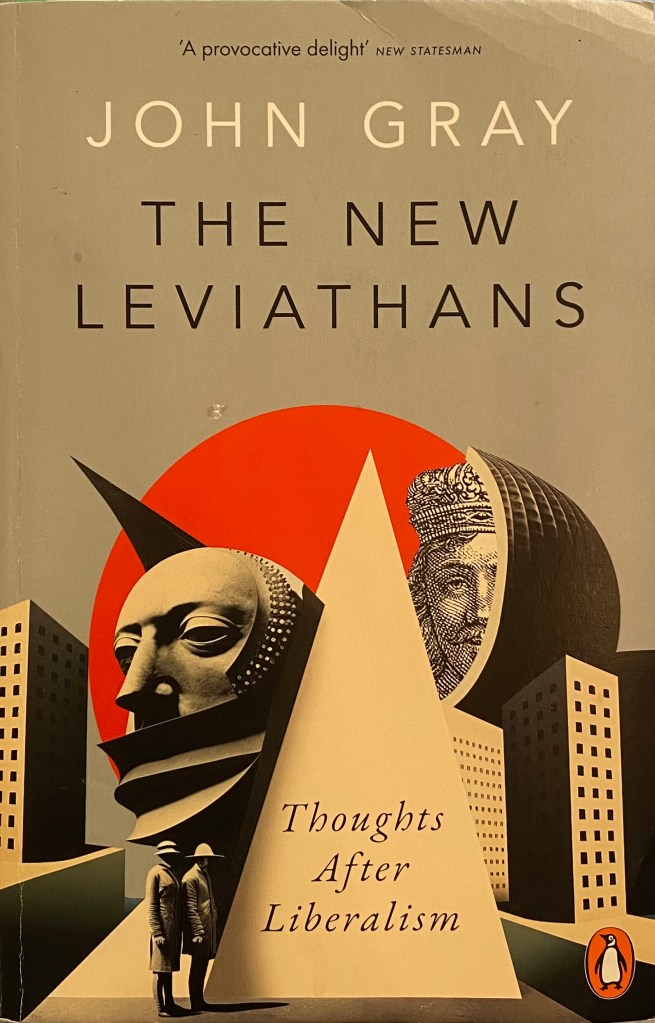
John Gray is one of those thinkers who can criticize mainstream thought and still get his books reviewed by the establishment. Doubtless this is because, however trenchant his criticism of liberalism, he is firmly committed to liberal values, insofar as they denote a willingness to share space with those who are different. But Gray is no liberal by his own definition of the term. He is highly skeptical of soteriology by means of free markets; he rejects the liberal universalism so common to liberal doctrinaires, along with the idea that what is good for the goose must be equally good for the gander; and he dismisses the notion that the liberal order is the apotheosis of human civilization, a gift that keeps on giving. Pace Fukuyama and friends, who promised in the early 1990s that the liberal order of the West was the endpoint of human history, for Gray the postwar liberal era was a historical aberration. Not only has liberalism not gone global and taken root in non-Western countries with strong autocratic traditions, liberalism is dying by a thousand cuts in the West. This is the thrust of Gray’s latest work, The New Leviathans: Thoughts After Liberalism (2023).
The title is a nod to Thomas Hobbes, who, according to Gray, is about the only liberal still worth reading and whose thought percolates through Gray’s book. Hobbes argued that society was forever at risk from falling into the state of nature, into a “war of every man against every man.” Leviathan was the sovereign tasked with protecting man from other men and from himself. But, Gray writes, the objectives of Hobbes’s Leviathan were circumscribed by its duty to keep society safe and secure. Hobbes’s Leviathan was concerned with keeping internal and external threats at bay but had no interest in the souls of its subjects. The new Leviathans are far more ambitious – they seek to obtain meaning in life for the citizenry. By extending their dominion over the hearts and minds of their subjects, the new Leviathans are nothing less than “engineers of souls.” This is true of Western and non-Western states alike; they just go about it in different ways. China relies on mass surveillance, Russia uses propaganda and blunt force, while the West (at least the English-speaking part of it) undermines its traditions of freedom by promoting identity politics. The result is “the return of the state of nature in artificial forms.” Instead of acting as guarantors of security, as Hobbesian Leviathans would, the new Leviathans spawn insecurity and destabilize societies. China does it through technology exports and acquisition of Western assets; Russia, by engaging in economic and cyber warfare; Western societies, by promoting manifold identity groups and pitting them against each other. As the book’s subtitle suggests, liberalism is going the way of the dodo.
Gray proceeds to diagnose the state of malaise in China, Russia, and the West. He has the least to say about China. Aside from the appeal of illiberal Western thinkers (notably, Carl Schmitt) to many Chinese intellectuals, any reader who has heard of China’s social credit system and witnessed the worldwide emulation of its pandemic measures in 2020 is unlikely to learn anything new. Russia, on the other hand, gets plenty of space; Gray sees an important parallel between the intellectual climate of the final decades of tsarist Russia and that of the modern West. In both cases, deracinated intellectuals embraced radical ideologies that became secular religions and attacked traditional society from within. In the case of the Russian intellectuals, the ideology was communism; in the case of modern Western intellectuals, it is what Gray calls hyper-liberalism and what is more commonly known as woke ideology. Gray believes that hyper-liberalism is a pathological offspring of liberalism and stems from the failures of the liberal project: staggering economic inequality, an overproduction of elites, and an inability to deliver “universal salvation inculcated by Christianity.” In Gray’s analysis, liberalism is a “footnote to Christianity,” while hyper-liberalism is a “vehicle for Christian hopes of a new world.” But where the Russian radicals understood they were in the process of deifying man, the hyper-liberal intellectuals of the West are clueless. They remain blind to the obvious contradiction in their ideology – the extreme individualism, doctrinal meliorism, and ideological universalism of their ideas represent the quintessence of the very civilization they are trying to dismantle. They are deconstructing the West using Western tools, and they labor under the illusion that these tools will work equally well in other parts of the world. Just like the Russian intellectuals, they are doomed. Far from the triumph of Western civilization and modernity, hyper-liberalism represents the last gasp of a dying animal. The future, Gray promises, will be much like the past – “disparate regimes interacting with one another in a condition of global anarchy.” The future will not only be non-Western; climate change and other environmental challenges will conspire to make it post-Anthropocene. Man’s domination over the planet is over.
Such is the nub of Gray’s argument. The rest is conversation, and it is one larded with digressive ruminations and anfractuous asides. The inclusion of such fascinating but obscure figures as Konstantin Leontiev and Vasily Rozanov is a testament to Gray’s breadth of knowledge, but does little to advance the thesis, and the reader is left with a book that would have worked better as an article or essay. To be sure, Gray has lost none of his perspicacity, and his observations are as lucid and cliché-free as ever. He is right to deride the strange belief in Russia’s moral superiority espoused by some right-wingers in the West as a “decadent fever-dream,” and he is equally right to fear the possible disintegration of Russia some Western liberals like to cheer for. His debunking of ideological consanguinity between Marxism and hyper-liberalism is dead-on, as is his witty dismissal of “populism” as a catch-all term that liberal elites use to describe the reaction against their own policies. He correctly establishes a connection between Christianity and liberalism, identifying the latter as a secular version of the former. But while he describes the similarity of patterns in Christianity and liberalism, he never attempts to explain why liberalism originated from Christianity. His emphasis becomes misplaced, and Gray runs aground.
In his seminal Christianity in World History, the Dutch theologian Arend Theodoor van Leeuwen introduces the concept of the ontocratic model. Ontocracy is the idea of cosmic totality, and it guided ancient pre-Christian civilizations. At its simplest, in the ontocratic model the sovereign is conflated with God. The story of the ancient Jews is one of a struggle against the ontocratic model; in the Old Testament, the Jews are in a dialectical relationship between ontocracy and theocracy, the kingdom of man and the kingdom of God. The request for Samuel to find the Jews a king and God’s response that it is a rejection not of Samuel but of God (1 Samuel 8:4-7) is an example of this. In the New Testament, the dichotomy of God and Caesar is made explicitly clear, and the fight against the ontocratic model reaches its climax – God lowers Himself to become man and thus make man godly. In the 11th century, Pope Gregory VII challenged the absolutism of the Holy Roman Emperor by setting up the church as a second locus of power, and where there is a choice, there is freedom. The difference between the ontocratic way and the Christian one is the difference between God as king and God as man. As van Leeuwen suggests, while every society is at risk of succumbing to ontocracy and European societies repeatedly flirted with the ontocratic model throughout history, liberalism – and the attendant belief in human rights – could have never come about in an ontocratic civilization.
No reader of Christianity in World History would agree with Gray’s glib description of Christianity as an “accident of history.” The idea would have certainly incensed the Russian philosopher Nikolai Berdyaev, whom Gray quotes repeatedly but in contexts that reveal nothing of Berdyaev’s main ideas. Berdyaev wrote that the pre-Christian conscience was inherently ahistorical; as Gray notes himself, it was a world that regarded history as cyclical and thus endless. Christian eschatology rendered history finite and the human conscience historical; far from being an accident of history, Christianity defined it. The Christian faith was revolutionary in that it freed man from nature and made him its master. But Humanism removed God from the equation and made man the measure of things, depriving him of his point of reference and of his vitality. Without a God to believe in, man becomes orphaned, and his need for faith bubbles up in other domains. This is something Gray acknowledged in his earlier works but something he passes over in The New Leviathans (though he does mention that hyper-liberalism is an alternative for those who cannot live without the hope offered by Christian doctrine). Many have written about the religiosity of Bolshevism, which van Leeuwen aptly describes as a “Christian heresy.” Liberalism, too, is a Christian heresy and not a “footnote to Christianity,” as Gray asserts. (Man’s need for faith can manifest itself in non-political domains as well; we witnessed this recently during the pandemic, when science was elevated to “the Science.”) Gray’s claim that Jesus “addressed his message not to all of humankind but to other Jews” is badly in need of qualification. Van Leeuwen vigorously contests the notion of Israel’s biblical “particularism”: God promises to make of Abraham a “great goy,” goy originally meaning “nation” and not what it came to mean later. “Israel and the land of Israel represent the whole earth, the whole of mankind.” Gray’s “other Jews” were a stand-in for the human race; Jesus addressed his message to the world in toto.
Berdyaev made a distinction between culture and civilization: the former is the cultivation of man’s inner world, while the latter is the cultivation of his outer world. Every culture comes with a dialectic – it contains both reservoirs of vitality and the seeds of its own destruction. At some point, man shifts his attention from his spiritual state to his surrounding world, and culture morphs into civilization. While we need not subscribe to Tolstoy’s historiosophy and negate the agency of man in historical processes, history cannot be understood without some consideration of metaphysics. When the question of metaphysics is absent, we are forced to fall back on a subversive déclassé intelligentsia to explain historical events, whereas the Russian radicals and the hyper-liberal ideologues of today might be nothing more than an epiphenomenon. But Gray does not wade into metaphysics, and the attempt to infuse his pessimistic The New Leviathans with a dose of optimism cannot be anything but hollow. “If we go on, it is because we cannot do otherwise,” reads the penultimate sentence of the text. Whatever the merit of Gray’s argument concerning the demise of the liberal age, a philosophy that can come up with nothing better to explain why we bother waking up in the morning only takes one so far.
 The Writings of Scriptor Adorans