Book in the spotlight: Cyril Hovorun’s Eastern Christianity in Its Texts
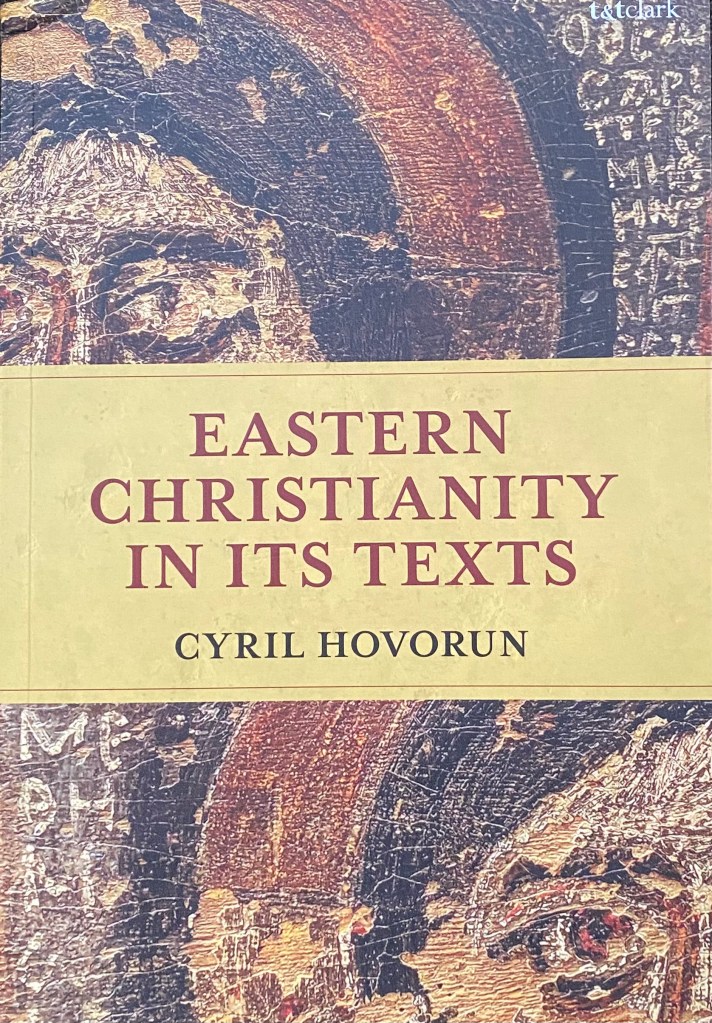
In the introduction to his Eastern Christianity in Its Texts, Cyril Hovorun describes his undertaking as an “annotated florilegium” – an anthology of excerpts from texts written by past theologians of import. Fortunately for the reader, this vast, scholarly exploration of the history of Eastern Christian theology is a lot more than that. It is a story of what makes Eastern Christianity tick, and Hovorun, a Ukrainian archimandrite defrocked by the Moscow Patriarchate and presently a professor at a religious institution in Sweden, tells the story well. Don’t let the apparent density of the text put you off – the specialists are not meant to be the only audience. The past is prologue to, if not the future, then certainly the present, and this work is essential to a better understanding of much of what goes on in the world today. Eastern Christianity in Its Texts is as much about the Church Fathers as it is about us.
The book rests on two theses. The first concerns the role of scholasticism in Eastern Christianity. Since the 19th century, the consensus among Eastern Orthodox theologians has held that scholasticism is a Western invention. In The Orthodox Church, the English-born Eastern Orthodox theologian Timothy Ware writes that scholasticism was one of the reasons why the rift between Western and Eastern Christianity grew in the Middle Ages: while Byzantium remained faithful to the patristic tradition (the tradition of the Church Fathers), Western Christianity embraced scholasticism, “that great synthesis of philosophy and theology worked out in the twelfth and thirteenth centuries.” Hovorun takes issue with this view. He sets out to prove that early Eastern Christian theologians used Aristotelian logic to formulate Christian theology. Backed by a broad array of primary sources and an impressive bibliography, Hovorun’s arguments are convincing. I will leave it to worthier minds to determine whether he is right, but if he is, this can promote interfaith dialogue and ecumenical understanding.
The second thesis centers on the distinction between tradition and traditionalism. Hovorun defines the former as “the Revelation” (that is, the Holy Scriptures) and the latter as strict adherence to the past in the name (but, as a rule, not in the spirit) of tradition. While traditionalism is usually championed by conservative thought, Hovorun judiciously points out that no tradition ever comes into the world as one; at its inception, any tradition is, ipso facto, an innovation and, more likely than not, heresy. “In contrast to the stereotype,” Hovorun writes, “orthodoxy is innovative and heresy is traditionalist.” The obvious conclusion is that conservatism not only fails to be innovative; it also runs the risk of being heretical. The distinction between tradition and traditionalism has important implications, since traditionalism often attempts to hijack tradition in the name of various causes. If Hovorun is correct, to ward off traditionalism is to protect the purity of faith.
These two arguments require more than 700 pages to advance, but it is not an arduous read. The text is far from impenetrable, and while Hovorun’s syntax would have benefited from greater editorial oversight, his textbook presentation of the material makes for easy approachability. The text is further enlivened by the liberal use of black-and-white photos from the author’s personal collection. There are seven chapters in total. Taking up about a fourth of the book, the first one expounds the historical background of Eastern Christianity. No mere summary of historical events, this is a fascinating interpretation of both past and present. As Christianity evolved from a persecuted religious minority to the dominant religion of the Roman Empire, it became a state institution. Eastern Christianity defined the Byzantine Empire, which in turn would define the history of Rus’ (Russia). After the demise of Byzantium, the center of Orthodox Christianity moved to Muscovy. Russian theologians have made important contributions to Eastern Christian theology over the past two centuries, and Russia is currently home to the greatest number of Eastern Orthodox Christians anywhere in the world, at least nominally. Knowledge of Eastern Christianity is the gateway to understanding Russia.
To the extent that religion continues to shape Russian identity and society, it is a commonplace in some ideological currents that the reason for Russia’s attachment to autocratic forms of government is Eastern Orthodoxy. An excellent exponent of this point of view is “Flight from Byzantium,” an essay by the Nobel Prize-winning poet Joseph Brodsky. The Russian-born Brodsky traveled to Istanbul sometime in the 1980s and the city he saw – the heart of Byzantium, the cradle of Eastern Orthodoxy, the so-called “second Rome” – was not at all to his liking. The disdain went beyond aesthetic considerations. Brodsky, who had been mistreated by his homeland, thought that the genesis of Soviet totalitarianism could be traced to the Bosphorus. His essay argues that Byzantium was ontologically despotic; it was the antipode of the West (Rome) long before the Ottomans showed up. Although the Byzantine Empire fell to the Turks, it managed to export its civilization north to Russia, which, in Brodsky’s telling, came to Rus’ as a disease. In this analysis, Russia’s despotic tradition owes itself to its Byzantine heritage. Stalin (or, for that matter, Russian autocracy in its modern iteration) was the direct descendant of all those Byzantine emperors; since Byzantium came to Rus’ by way of religion, it follows that Eastern Orthodoxy is to blame.
Hovorun does not paper over the historical contiguity between the Byzantine Church and the Byzantine state. He introduces the concept of “symphony” – in Byzantium, a partnership between church and state in which both shared the levers of power. This partnership led, or could lead, to a conflation of church and state that Hovorun calls “theopolitical unity.” Hovorun mentions the famous letter from the Patriarch of Constantinople, Anthony IV, to the Grand Duke of Moscow, Basil I, reminding the Russian ruler that a Church without an emperor was an impossibility. Theopolitical unity explains why Eastern Orthodox churches have reflexively sought out a close relationship with the regimes under which they operated, even unsavory ones. Superficially Brodsky appears to have been right. In truth, things are much more complicated, and far from siding with Brodsky’s camp, Hovorun proceeds to offer a welcome rehabilitation of the Byzantine Church. Maximus the Confessor and John of Damascus, both of them Church Fathers (Maximus was also a high-ranking official in the Byzantine bureaucracy), staunchly defended the separation of church and state. The Patriarch of Constantinople Photius is believed to have challenged the anti-symphonic tradition of political theology dating back to Eusebius. Whereas Eusebius had believed that the emperor represented the image of Christ, in Introduction to the Law Photius supplanted the emperor with the patriarch, thus reinforcing the idea of symphony and political dualism. This is an important point. Eugen Rosenstock-Huessy wrote that a dilemma is a precondition for liberty; while no man is free to do as he likes, he is free when he has a choice. In political terms, this presupposes the existence of two different powers to balance each other. Rosenstock-Huessy argued that European freedom was born when Pope Gregory VII set himself up as an alternative to the Holy Roman Emperor; for him, the “Papal Revolution” was the first true Western revolution. But Gregory VII was an 11th-century pope; Photius lived in the 9th century, and the concept of symphony was codified in the Byzantine Empire in the 5th century.
Hovorun notes that when emperors encroached upon the sovereignty of the Church, republican institutions such as the senate suffered too. The Byzantine Church was actually a very republican institution. It ensured there were checks and balances, and its inability to always do so is a testament not to the failure of the symphony system but to the insidious powers of corruption that always find their way into the social fabric. Pace Brodsky, one might well argue that Russia’s problem was that Byzantium influenced it too little, a position taken by Georgy Fedotov, a 20th-century Russian thinker. Fedotov argued that the reason why Russia was never exposed to the Renaissance was that it had received the religion of Byzantium but not its language. Western Europe – prior to the Reformation at least – had to read the Holy Scriptures in Latin, which made it possible for it to remain connected to Roman civilization. In the case of Russia, it received the Bible in Old Church Slavonic. This made Christianity more accessible for the Slavs but at a cost – they were largely cut off from Greek heritage with its Homers and its Platos. Insofar as Byzantine civilization was able to leave an imprint on Russian culture, it only enriched it: the victory of Byzantium’s Hesychast movement, on which more later, spawned a blossoming of the arts in Rus’, as evidenced by such figures as Theophanes the Greek and his famous student Andrei Rublev.
Brodsky traces a straight line from the Second Rome to the third, from Constantinople to Muscovy. But this is an exercise in reductionism that ignores the dualistic nature of Russia and its history (while on the subject, as Hovorun observes, it also ignores the fact that Byzantine ideologues considered Constantinople as a new Rome and not a second one; the idea of the Third Rome was floated by an obscure monk from Pskov). Russia has historically been a land that looked both east and west, a land of two countries. An astute reader of history, Hovorun tells the reader how the cleavage came about. While Kyiv was the place where Russian Orthodoxy began, the city was sacked by Mongol armies and eventually absorbed by the Grand Duchy of Lithuania, which at the time was sufficiently Orthodox to become a contender for the title of Rus’. Hovorun writes:
This ‘Lithuanian’ Rus’ counterposed itself to the ‘Mongolian’ Rus,’ which remained under the control of the Golden Horde. The two Rus’es, as it were, developed hostility to each other, which in a sense continues to our days . . . The Lithuania-controlled principalities, in their turn, found themselves at the European frontier facing East.
These lands are known today as Belarus and Ukraine. Ukraine’s insistence that it is part of Europe and its defiant refusal to be subsumed by Putin’s “Russian World” are grounded in historical reality.
The story of “two Rus’es” is a much overlooked part of history. Reading Byzantium and the Rise of Russia, a superb monograph by the notable 20th-century theologian and historian John Meyendorff, one might be forgiven for thinking that the Grand Duchy of Lithuania stumbled into Catholicism. It could have just easily stumbled into Eastern Orthodoxy, and in point of fact it nearly did. Lithuania’s decision in favor of Catholicism – the consummation of its marriage with Poland inspired by political considerations and the prevailing balance of power rather than any religious fervor – is one of those historical accidents that tempt imaginations into the unprofitable enterprise of tinkering with the past perfect. As Meyendorff describes, before its union with Poland, Lithuania considered itself to be a Russian state, if not the Russian state, and, in the middle of the 14th century, it served as Eastern Orthodoxy’s bulwark against the Teutonic Knights and Poland – in other words, the “West.” At one point, Meyendorff writes, Vilna (Vilnius) came close to supplanting Moscow as the capital of what would later be a united Russia. Working to prevent balkanization among Slavic, Eastern Orthodox lands, the Byzantine Empire had to choose between “two Russias.” It chose Muscovy – “Mongolian” Rus,’ whose “rulers,” Hovorun writes, “now called tsars, often acted as Mongolian khans: insidiously and cruelly.” Had Byzantium chosen Lithuania, history might have looked very different, and in that sense Byzantium’s role in Russian history was decisive. The divide between “European Russia” and “Asian Russia” that came about with Peter the Great is just a secular manifestation of an older religious conflict in which the Byzantine Empire had a hand. Even so, Russia’s attachment to autocracy is a legacy of the Golden Horde and not, as Brodsky’s camp asserts, of Byzantium.
“Dialectics,” the second chapter, is a lot more technical, but it is key to understanding Hovorun’s argument. Scholasticism can be defined as a school of thought that uses ancient Greek philosophers as scaffolding to construct and buttress Christian doctrine. As mentioned earlier, Eastern Orthodox theologians tend to dismiss scholasticism as a Western invention foreign to Eastern Orthodox thought. For instance, in The Mystical Theology of the Eastern Church, a text now considered a classic, Vladimir Lossky categorically rejects any attempts to find traces of scholasticism in the Church Fathers. For Lossky, a leading 20th-century Eastern Orthodox scholar, resemblances between the thought of the Church Fathers and Plato are external, not reaching the core of their doctrine and merely reflecting the linguistic arsenal of that time. He peremptorily asserts: “Despite all its richness, the religious thought of the East had no scholasticism.” Those looking for closer connections are dismissed as “blinkered minds incapable of rising above rational concepts” and are more or less told to get a life. Hovorun challenges this view. He insists that at the time of the Church Fathers scholasticism was actually a “secular” concept, if one can talk of secularism in the age of antiquity. The Church Fathers had to render Christian theology into language understandable to pagans. Since the Greek philosophers were the golden standard, Christian theologians used pagan concepts to formulate their “meta-language,” as Hovorun refers to the language of Christian theology. They used scholasticism precisely because it was “secular” – in the sense that it was free of pagan or any other kind of metaphysics. In one of history’s great ironies, Christian application of scholasticism was turned into a weapon against Christianity during the Enlightenment, when secularly minded thinkers attacked metaphysics and scholasticism became a dirty word.
But the Enlightenment thinkers weren’t the only ones who went after scholasticism; Eastern Orthodox theologians came to associate it with Western theology and proceeded to purge it from Eastern Orthodox thought. Hovorun says that this anti-scholasticism began in the 19th century, but perhaps it had begun earlier with the Hesychast movement. Hesychasm emerged in the Middle Ages and was championed by Gregory Palamas, a 14th-century monk and archbishop. Centering on contemplation and the Jesus Prayer, it was, according to Meyendorff, a turning point in the history of Byzantine civilization. For centuries Byzantium had been in a dialectical relationship between Jerusalem and Athens. The Hesychasts were monks and represented Jerusalem; their opponents were Byzantine humanists who represented Athens. It was the Hesychasts who carried the day, and their victory was interpreted by the humanists as a tragedy. Meyendorff is more restrained: the Hesychasts were not exactly a benighted lot, and had the humanists won, Byzantium would have been reduced to a purely Greek, nationalist phenomenon. The triumph of the monks was a guarantee of Byzantine universalism and thus a sort of cosmopolitanism; additionally, it strengthened the autonomy of the Church vis-à-vis the emperor and led to the Russian cultural effervescence mentioned earlier. Nevertheless, Palamas opposed the use of Aristotelian logic in theology and proclaimed patristics as the only appropriate framework for Christian theology. The roots of the anti-scholasticism evinced by Hovorun may be much deeper.
Whatever the case, Hovorun is unequivocal: the Church Fathers cannot be fully understood without scholasticism. Just because it was misused as an instrument does not mean the instrument itself is inherently defective. Nor is the removal of such an instrument without risks – absent scholasticism, Christian doctrine jeopardizes its monotheistic cohesiveness. Is Hovorun right? Reading Lossky, one senses a contradiction. On the one hand, Lossky says that the only way to know God is through apophaticism (defining God by the process of negation, that is, by focusing on what God is not). On the other hand, he makes positive statements about the Holy Trinity. But if one cannot define or know God, how can one make any positive statements about Him? (While we are on the subject, touring the monasteries of Meteora a few years ago, I was surprised to see illustrations of ancient Greek philosophers on an outer wall inside a monastery complex, with an accompanying text explaining their contribution to thought – clearly the monks had no problem giving pagans credit where credit was due.) According to Hovorun, this is where scholasticism comes in. Without it, one risks falling into a trap of one’s own making. Hovorun’s extensive citations from texts written by Church Fathers make for compelling evidence, and while chapters 3-5 (the use of scholasticism to interpret the questions of salvation, the Holy Trinity, and Reincarnation) might lead the casual reader to wonder whether all the endless disputations about energies and essences are little more than splitting hairs, keep in mind that back then a theologian was a semicolon away from falling into heresy. Fortunately for those of us who are believers, it is sufficient to believe, and a more appropriate question, then, is not whether Hovorun is right, but whether it matters.
It does. If Hovorun is correct, Eastern and Western Christianity have one more thing in common they can talk about. The implications are directly related to his second thesis: the distinction between tradition and traditionalism. While I would personally refrain from making the connection, I believe Hovorun implicitly does: those who, like him, are willing to acknowledge the role of scholasticism in Eastern Orthodox theology are on the side of tradition; those unwilling to do so are likely to be traditionalists. In the seventh chapter (“Church”), Hovorun makes a case for ecumenism. Acknowledging the validity of the need for conservative factions to stick to the traditions of their respective churches, he argues that adherence to traditions can jeopardize the Tradition itself (i.e., the Revelation). Hovorun points out that the early Judeo-Christian community also faced a choice between immuring itself in a fortress and engaging with the pagan world. It chose the latter and became universal. Traditionalism works against universalism; to the extent that Christianity must be universalist, traditionalism fails to heed the Christian message. Christian history has always contained the dialectics of faith and institution. Traditionalism is linked with the latter. In his Istanbul essay, Brodsky – whom I will mention one last time – provocatively writes that the polytheism of pagans was conducive to democracy, while Christian monotheism could only produce despotism. Hovorun debunks this: Christianity, he writes, is essentially democratic. Church ministry was originally highly egalitarian, making no distinction between clergy and laity; it was only when Christianity evolved into an institution that it developed a hierarchy, dividing its body into the ordained and non-ordained. There was nothing Christian about it: the hierarchy of the church “was remodeled according to the political and religious patterns of the Greco-Roman world,” patterns that were polytheistic. Hierarchy, in other words, was smuggled into Christianity through pagan channels. For Hovorun, the development of the Church as an institution “confirms that hierarchy is an accident, not the essence of the church.” He makes a bold statement:
Faith forms the church and is an inalienable feature of its nature. However, expressions of this faith evolved throughout the centuries. Therefore, various creeds and definitions, including the ones adopted at the ecumenical councils, cannot be seen as unchangeable – they are accidents of faith and the Revelation.
While not wrong, this can be a slippery slope. Christianity must surely always engage with the modern world, but viewing established traditions as mere accidents of the Revelation subject to change is bound to lead to concessions to modernity that will ultimately undermine the Revelation itself.
The strong link between Christian traditionalism and dualism is not obvious, but its existence is one of Hovorun’s startling conclusions. One of the most important themes of the final chapter, dualism has a black-and-white conception of the world – good versus evil. Specifically, dualism believes evil to be ontological, meaning evil is a feature and not a bug. This is a deeply anti-Christian position. Christian doctrine holds that God could not have created any part of the world evil. Nothing is inherently evil; it is only through will that evil acquires reality. Similarly, no one is born evil; one becomes evil by choosing to do bad things. Espoused by the gnostics, Manicheans, and other spiritual groups in the early days of Christianity, dualism is a heresy that continues to plague the Christian world as much as the secular one (Hovorun notes that conspiracy theories were in wide circulation among the gnostics). It is a lot less innocent than one might think. Once you dismiss part of the world as evil, you shut off that part of the world; evil is extrapolated to entire categories.
Human beings, to avoid evil, are requested not to observe what choices they make but to avoid touching certain things and staying in certain places.
Thus, some early Christians regarded the entire Roman Empire as evil; others have found evil in the female sex. Modern anti-ecumenism is also dualistic, since it conceptualizes those who are different as heretical. Dualism inevitably leads to polarization, to us versus the Other. Enjoying renewed interest in recent decades, gnosticism has been presented by some scholars as the victim of a power-hungry Church; in reality, the Church was right to be concerned. As Czeslaw Milosz wrote, if we view the world as ontologically evil, there is nothing left for us to do other than retreat into the underground to chew our nails or become Dostoevsky’s Grand Inquisitors. Neither alternative bodes well for humanity.
For Hovorun at least, the question of dualism is not an abstract one. In 2022 the Moscow Patriarchate defrocked Hovorun. The official transgression was having co-celebrated a liturgy with a representative of the Ecumenical Patriarchate in Ukraine, but Hovorun, who has been an outspoken critic of Russia’s war against Ukraine, maintains that the decision was politically motivated. Given the Moscow Patriarchate’s recent track record – its proximity to the Kremlin is a classic illustration of a “symphonic” disruption – one is inclined to believe that Hovorun is indeed a victim of the very dualism he decries in his book, a dualism that is not just spiritual but also political. As he said during one interview, Putin’s “Russian World” is a dualistic concept: it sees Russia as the realm of good opposing the evil realm of a corrupt, malevolent West. Hovorun does not mention the war in Ukraine in the book, but then he doesn’t need to. For Hovorun, as for millions of other Orthodox Christians, the existence of dualism is a tragic reality.
Nevertheless, there is hope. Hovorun appropriately concludes Eastern Christianity in Its Texts with three well-known 20th-century Orthodox Christians: Nikolai Berdyaev, Maria Skobtsova, and Elisabeth Behr-Sigel. Berdyaev was an extraordinarily latitudinarian, if idiosyncratic, philosopher; Skobtsova, a nun who helped save Jews in Vichy France and perished at Ravensbrück; and Behr-Sigel was a convert to Eastern Orthodoxy whose long life spanned the 20th century and who militated for a greater role for women in the Church. All three are a poignant reminder that now, as two thousand years ago, there are people prepared to safeguard the Revelation, spread the message of Christ, and promote the awareness that, in the end, commonalities are more important than divisions.
 The Writings of Scriptor Adorans